
How PVC Pipe Making Machine Manufacturers Are Developing Solutions for Recycled PVC Processing
Post-industrial polyvinyl chloride (PVC) recyclate offers pipe producers an opportunity to reduce material waste and make better use of production offcuts, rejected components, and other recoverable resources. Yet recycled material rarely behaves exactly like virgin resin. Its thermal history, additive content, particle size, and contamination level can all influence melt flow and finished-pipe properties.
For PVC pipe making machine manufacturers, the challenge is to accommodate these variations without compromising dimensional stability or the requirements governing the final application. Effective processing depends on coordinated changes to material preparation, feeding technology, screw design, and quality verification, rather than simply introducing recyclate into an existing formulation.
Adapting Compound Feeding Systems to Recyclate Variability
Post-industrial PVC recyclate can vary considerably even when it originates from a single factory. Clean, internally generated pipe scrap may have a relatively predictable composition, while mixed production residues can contain different stabilizer packages, pigments, fillers, or traces of incompatible polymers. Before processing begins, recyclers need to classify material by source, composition, and previous thermal exposure. Screening, size reduction, and contamination checks help create more consistent feedstock, reducing the risk that irregular input will translate into inconsistent extrusion output.
Feeding equipment also needs to accommodate differences in bulk density, particle geometry, and flow behavior. Ground PVC may contain flakes, granules, or fine particles that move differently through a hopper. Bridging, segregation, and intermittent feeding can cause fluctuations in the material supply, affecting melt pressure and wall-thickness consistency. Agitators, suitable hopper geometry, and carefully selected metering devices can improve material movement. Where recycled compound is blended with virgin resin, gravimetric dosing can help maintain the intended ratio by measuring material mass rather than relying solely on volumetric delivery.
Stable feeding is particularly important when recycled content varies between batches. A documented blending procedure can specify acceptable recyclate proportions, moisture or contamination limits where relevant, and the conditions under which a batch requires additional inspection. Operators should also track changes in motor load, melt pressure, and output rate after a new batch enters production. These indicators cannot identify every material defect, but their trends can reveal processing instability early enough for investigation. PVC pipe manufacturing machine configurations that accommodate controlled dosing and practical process monitoring give manufacturers greater flexibility when handling recovered material.
Adjusting Screw Geometry for Recycled PVC Compounds
PVC requires careful thermal management because excessive heat exposure can trigger degradation, including discoloration and the release of hydrogen chloride. Recycled material may have already experienced heat and shear during its first processing cycle, making its previous thermal history an important consideration. Screw design must balance melting, mixing, conveying, and pressure development without exposing the compound to unnecessary mechanical stress.
The conveying and compression sections influence how material moves through the barrel and develops a stable melt. Excessive shear can raise melt temperature, while inadequate mixing may leave variations in additive distribution or compound consistency. Screw selection should account for the formulation, recycled-content percentage, throughput target, and required pipe properties. Changes to channel depth, compression behavior, and mixing elements need to be evaluated as a coordinated system rather than treated as isolated upgrades.
Process adjustments should be validated using measurable outcomes instead of visual appearance alone. Melt pressure stability, output consistency, surface quality, dimensions, and mechanical performance provide complementary evidence of whether a recycled formulation is running appropriately. A compound that appears smooth at the die may still produce pipe with unsuitable impact resistance or long-term pressure performance. For this reason, PVC pipe making machine manufacturers need to consider the interaction between screw geometry and the complete formulation, including stabilizers, lubricants, impact modifiers, and fillers.
Maintaining Product Certification When Incorporating Recyclate
Recycled content does not automatically make a PVC pipe unsuitable for certified applications, but acceptance depends on the relevant product standard, intended use, jurisdiction, and certification scheme. Requirements can differ significantly between pressure pipes, drainage systems, conduit, and other applications. A formulation change that is acceptable for one product may require additional evaluation for another. Manufacturers should establish the applicable requirements before changing recycled-content levels, especially where pipes must satisfy specified mechanical, dimensional, chemical, or long-term performance criteria.
Traceability is central to demonstrating that recycled material remains within an approved production process. Batch records should identify the source and classification of recyclate, its proportion in the compound, relevant additive information, and any deviations from the approved recipe. Production records can connect these details with extrusion conditions and test results for each manufactured lot. Such documentation helps quality teams distinguish normal process variation from changes that may affect product conformity, while supporting investigations when a batch fails inspection.
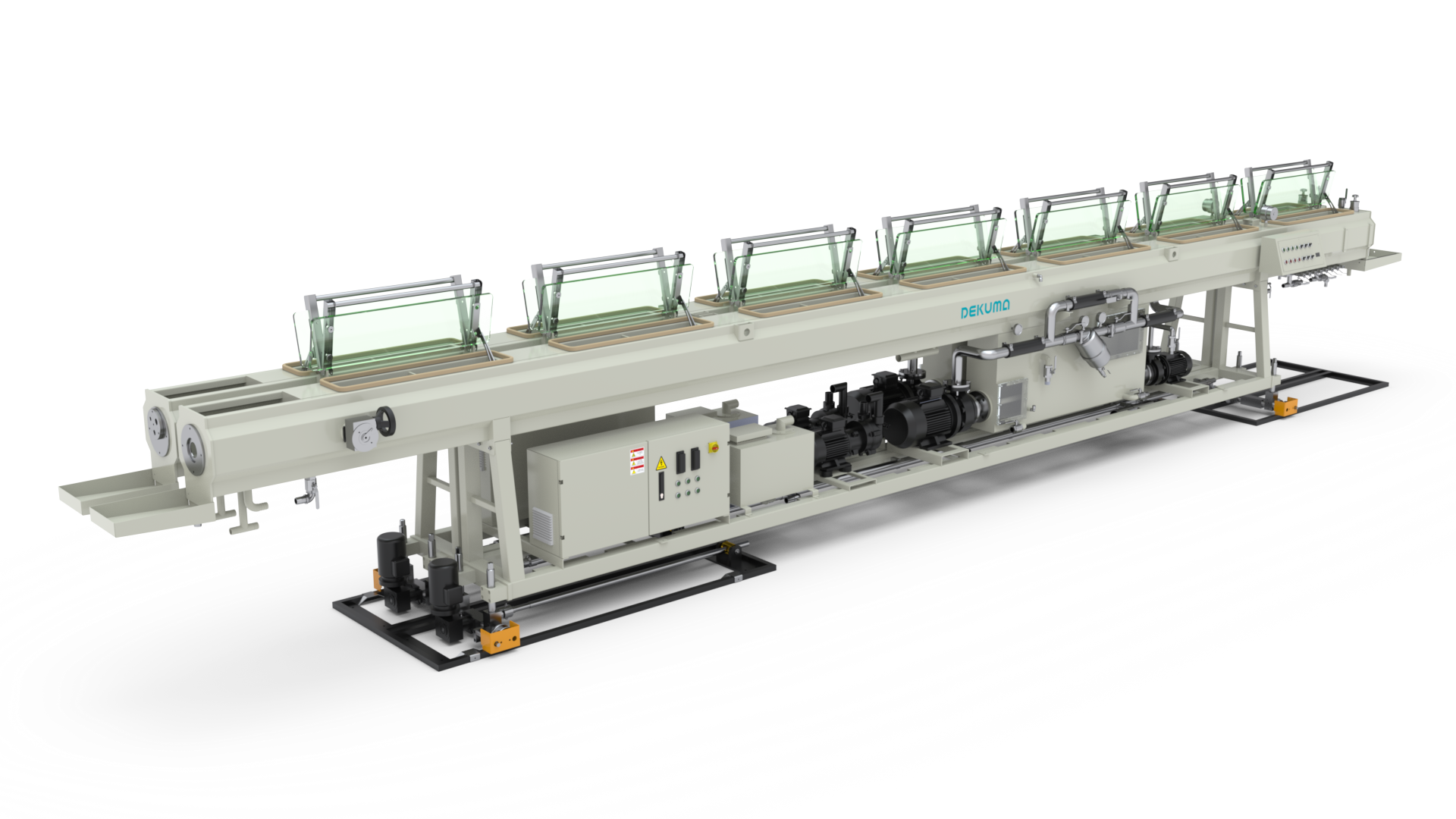
Verification must focus on the finished pipe as well as the incoming compound. Depending on the application and governing standard, evaluations may include dimensional measurements, impact resistance, tensile or other specified mechanical tests, and pressure or long-term performance testing. Any change in feedstock source, recycled-content percentage, stabilizer package, or processing conditions should be assessed through the manufacturer’s change-control procedure. PVC pipe manufacturing machine systems can support this process through repeatable operating conditions, accessible process data, and stable sizing and cooling.
Conclusion
The future of recycled PVC processing depends less on a single machine upgrade than on the relationship between material quality, process design, and product verification. Consistent feed preparation reduces avoidable variation; suitable screw geometry manages melting and shear; and traceable testing helps demonstrate that finished pipes meet their intended requirements.
PVC pipe making machine manufacturers can contribute by developing equipment that accommodates realistic changes in recycled compounds while supporting repeatable production conditions. Through coordinated process trials and application-specific quality controls, producers can incorporate suitable post-industrial recyclate with a clearer understanding of both its manufacturing benefits and its technical limits. DEKUMA‘s equipment capabilities form one part of this broader effort, in which sound material management and validated product performance remain essential.